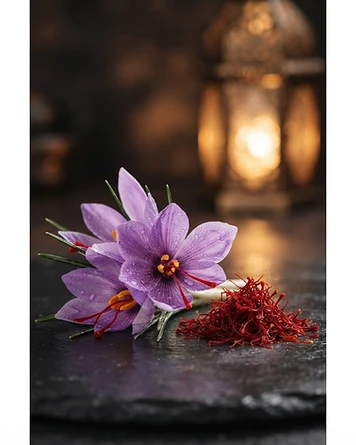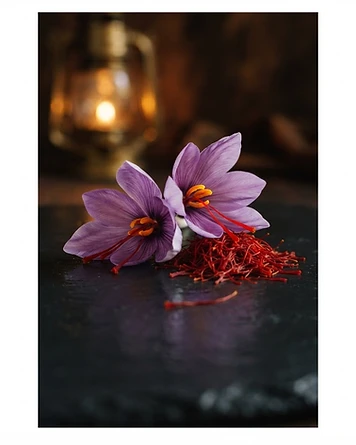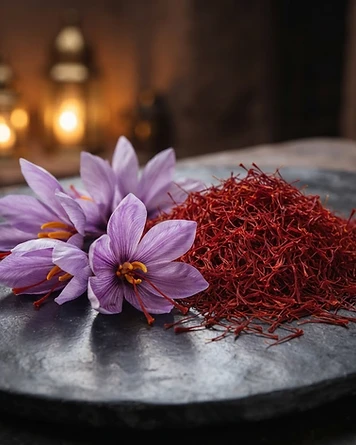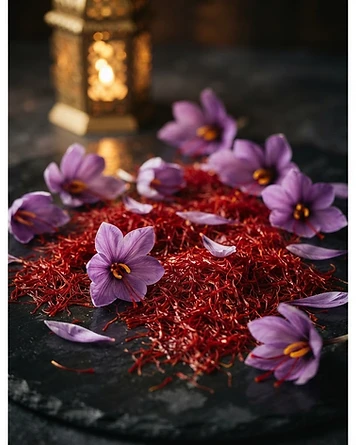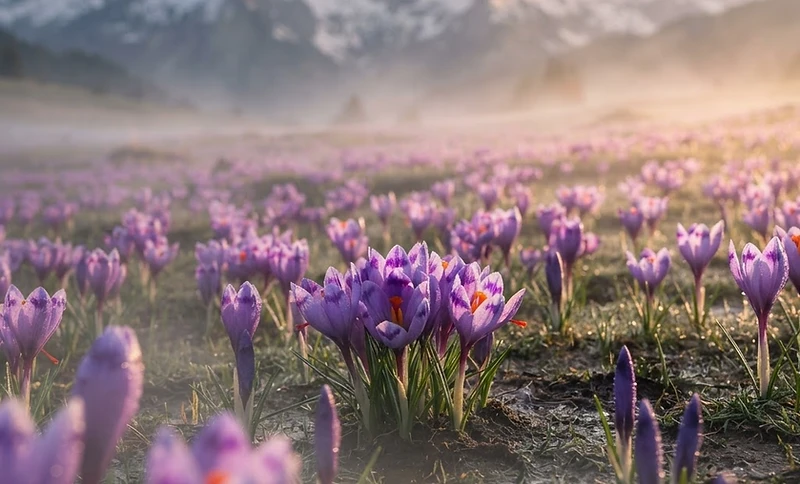
Saffron belongs to the high, dry country that runs from the eastern Mediterranean through Iran and into Central Asia, where cool nights and strong autumn sun suit an autumn-flowering crocus. It is grown in Afghanistan on small plots, and it is still picked and separated by hand.
Most saffron reaches a shelf without a name attached to the farm, the lot or the laboratory. We wanted the opposite: a short supply chain we can describe, and a record we can show. That is the whole idea behind the name.
We are a small Canadian company, not a grower. Our work is choosing the lot, having it tested, handling it properly and telling you exactly what we know and what we are still waiting to learn.
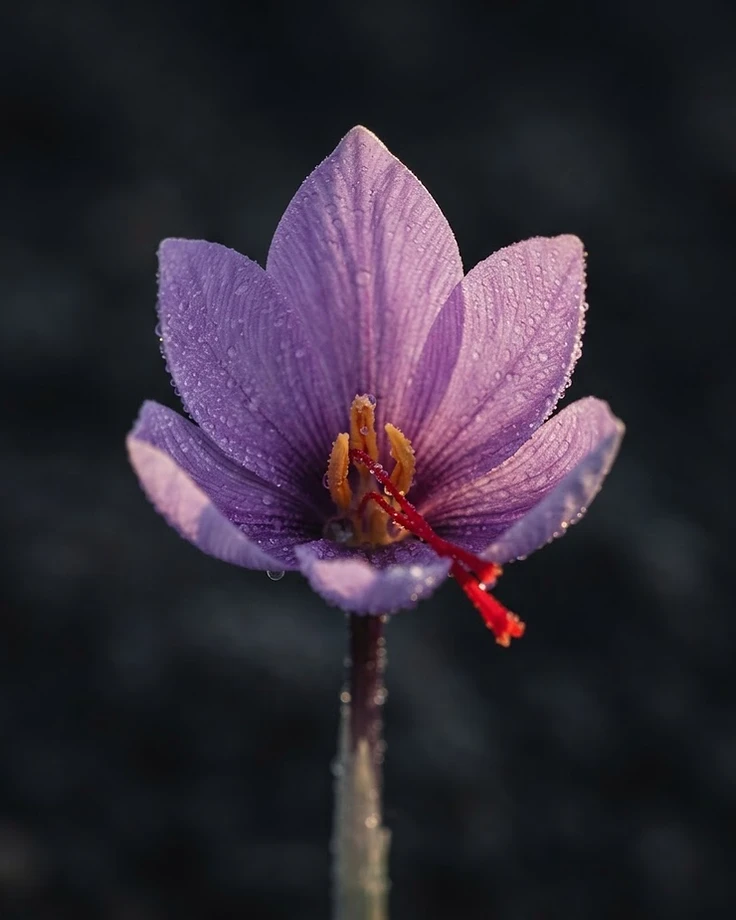
Crocus sativus · three stigmas to a flower
The heritage
A flower that has travelled for millennia.
Crocus sativus is a small autumn crocus. It is sterile, so it is grown from corms rather than seed, and each flower carries just three crimson stigmas. Those three threads, dried, are the whole of the spice.
Saffron has moved along trade routes for thousands of years, from the eastern Mediterranean through Persia and into Central Asia, carried in small quantities because a harvest is measured in grams rather than tonnes. In Afghanistan it is grown today on small plots, and every step of the harvest is still done by hand.
We make no claim to have discovered anything here. What we can offer is a short, documented chain from one lot to one jar, and a laboratory record published in public rather than kept in a drawer.
The harvest
Three weeks a year, picked by hand.

- 01
- Crocus sativus flowers for two or three weeks each autumn. The whole crop arrives at once, which is why the harvest is measured in days rather than weeks.
- 02
- Flowers are gathered by hand at first light, before the heat of the day opens them fully. It is delicate, slow work that cannot be mechanised.
- 03
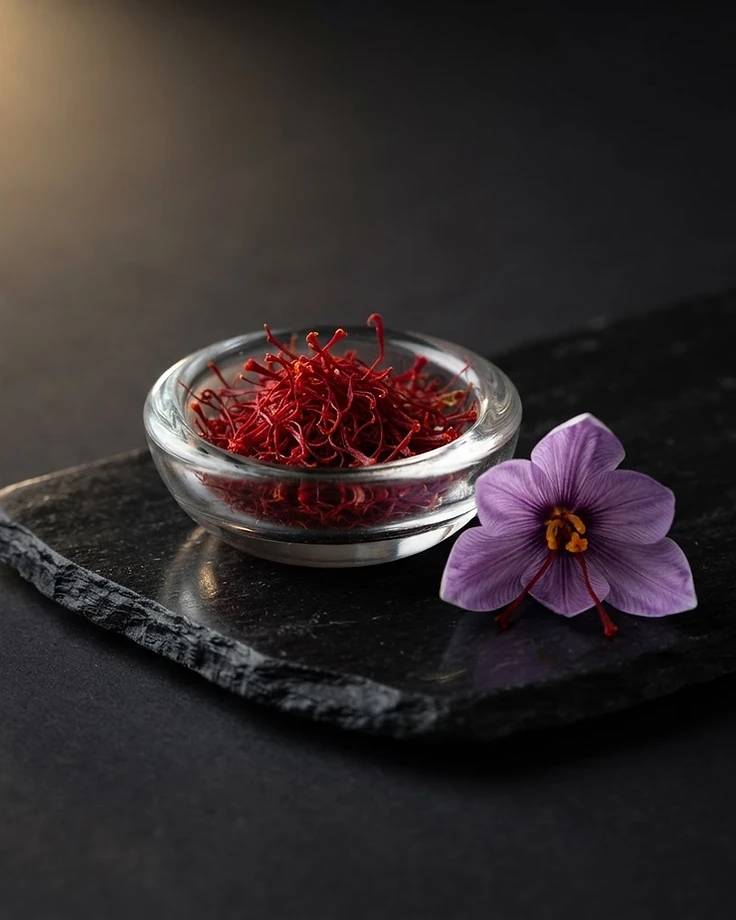
- The three crimson stigmas are removed from each flower the same day. Roughly 150 flowers yield a single gram of dried threads.
- 04
- Stigmas are dried gently and out of direct sun, then rested in sealed containers. Drying protects the colour and aroma that heat and light would otherwise take.
The bloom
The picking
The separation
The drying
Sourcing & transparency
Authenticity, written down.
We describe what we can document: the country of origin, the supplier's grade designation, and the laboratory results we hold. Where a test is still in progress, we show it as pending rather than leaving it out.
We buy from a single supply chain and keep the lot identifiable, so that a question about a jar can be answered with a sample reference rather than a shrug.
Grade A designation provided by our supplier. Independent laboratory verification is pending. No Canadian certification or independent grade verification is claimed.
- One sample, tested and published
- Results are shown against the sample they came from, with the laboratory, the method and the report date.
- No grade we have not verified
- The designations on our packaging are our supplier's. We say so wherever they appear.
- No certification we do not hold
- We do not describe our saffron as certified, approved or compliant with any scheme we have not completed.
Where we are going
Canada first. Then further.
Our first market is Canada, where orders will ship from Ontario with standard delivery. Our focus is getting that right before anything else: the packaging, the labelling, the paperwork and the results.
Longer term, the ambition is to introduce Afghan saffron to international markets on the same terms: documented, traceable and honestly described. We would rather grow slowly than overstate what we have.
The collection